
The Maryland General Assembly will wrap up Monday, April 13th after many hours of poring over legislation, tracking amendments, and hundreds of letters from Nature Forward’s members to their legislators. Read on to understand which of our priority bills were able to pass muster this session.
Sine Die Advocacy:
- Thank your legislators for their efforts this session — especially those sponsoring and cosponsoring our priority bills but also thank the legislators whose bills did not pass.
- Advocate to your legislators for inclusion of the House’s Data Center Transparency language to be added to the Utility RELIEF Bill.
- Urge your legislator to include data center updates, the Bottle Bill, CHERISH, and the Affordable Solar Act in their end-of-session wrap up letter.
This year, Nature Forward and Marylanders for Data Center Reform have been supporting bills that align with our general and data center legislative priorities:
- Establishing a Regulatory Framework: Data Centers lack comprehensive oversight over their water use, location, and power consumption.
- Understanding Environmental Impact: While Maryland has passed the Data Center Study Bill, overturning a veto by the Governor, more information is needed to understand the complete impact of data centers.
- Address Water Usage: Data Centers use millions of gallons of consumable water a day, which becomes contaminated by their chemical cooling processes.
- Protect Communities & Air Quality: Hyperscale data centers use more electricity and water than 10,000 individual households combined and often operate hundreds of polluting diesel backup generators. This can cause a strain in areas that are already vulnerable to water shortages or poor air quality.
- Transparency in the Development Process: Local governments and individuals often do not know who is behind the development of these data centers. We support legislation that increases the mandatory and publicly available reporting on new data center developments.
Of the thousands of bills that are introduced each session, less than one percent get passed, so we decided to prioritize six to address our legislative priorities.
As a reminder, Nature Forward started Marylanders for Data Center Reform in summer of 2025, and each group manages their own general assembly bills.
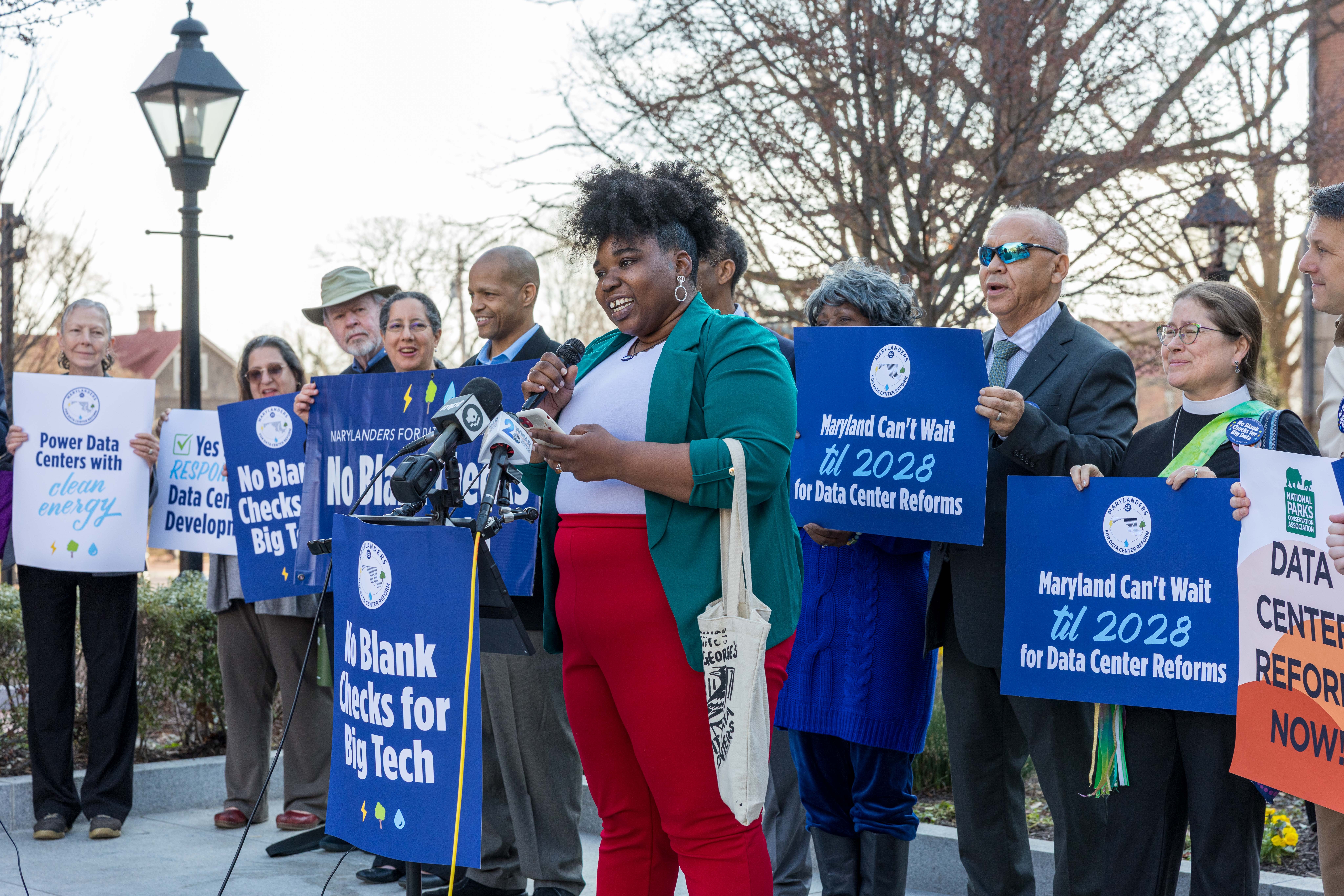
Marylanders for Data Center Reform’s Priority Bills
Data Center Clean Capacity HB 940 / SB 596 – Part of the Utility RELIEF Act
Sponsored by: D. Charkoudian and S. Hester
This Bill would create a voluntary electricity demand response program to reduce costs for ratepayers, increase grid reliability, and add new electricity capacity to accommodate development. This would be achieved by giving priority to customers who bring their own carbon-free electricity, agree to a demand response program, and implement battery backup storage.
What is Demand Response?
Demand response refers to a tradeoff where data centers and other large load energy consumers agree to a plan to lower their energy usage during peak times. For example, in the summer, when energy is strained because people are using their air conditioners, large load customers might schedule energy-extensive processes overnight instead of during the day. This also helps to conserve water resources used to cool these processes.
Registration and Demand Response Program for Large Load Energy Customers SB 992 – Part of the Utility RELIEF Bill
Sponsored by: Senators Hester, Feldman, Lewis-Young, Sydnor, Love, Hettleman, Ready, and Folden
Customers that use more power than 25 MW monthly (for context, the average household uses about 1.2-1.3 MWh per year) would have to register with the Public Service Commission before interconnecting with the electric system. Furthermore, a data center must agree to participate in a program that mitigates the strain on electricity resources, invest at least $2 million into their personal property (this means computers, operating systems, and other items that are stored inside the center, the state/locality gets the benefit of their tax dollars), and create at least 5 jobs that pay 150% of the state minimum wage in order to qualify for tax exemptions. (not moving forward)
Repealing Data Center Tax Exemptions HB 560 – Not Passing this General Assembly
Sponsored by: Delegates Palakovich Carr, Acevero, Bagnall, Boyce, Ebersole, Embry, Fair, Feldmark, D. Jones, Kaufman, Lewis, Lopez, McCaskill, Moreno, Ruff, Ruth, Stewart, Terrasa, White Holland, Wims, and Woorman.
This bill repeals a broad tax exemption for data center sales and use taxes. Currently, data centers that create at least 5 new qualified job positions (must be full time and indefinite duration, pay at least 150% of state minimum wage, newly created, and filled) and invest at least $2 million into their personal property qualify for the tax exemption. This bill would remove this exemption, requiring data centers to pay their fair share in taxes.
Property Tax Subclass and Special Rate for Data Centers HB 1595 / SB 427 – Not Passing this General Assembly
Sponsored by: S. Hornberger, S. Palakovich Carr, and D. Young
This bill allows counties and Baltimore City to establish a new tax subclass of personal property specifically for data centers and also sets a special tax rate for said personal property.
Data Center Planning and Transparency HB 1411 – Still Advocating for Inclusion in the Utility RELIEF Act
Sponsored by: Delegate Ruth
This bill would require local governments to design a transparent approval process for data center projects, one that would include community members through extended public notice and comment periods, and to make public disclosure of their plans.
Nature Forward’s Priority Bills:
CHERISH Act HB 1268 / SB 078 – Not Passing this General Assembly
Sponsored by: Delegates Behler, Acevero, Addison, Allen, Amprey, Bartlett, Boafo, Charkoudian, Coley, Foley, Fraser-Hidalgo, Holmes, Ivey, A. Johnson, S. Johnson, D. Jones, Lehman, Lewis, McCaskill, Pasteur, Phillips, Rogers, Ross, Ruff, Ruth, Smith, Taveras, Wilkins, Williams, and Senator Brooks.
Addresses environmental concerns that are related to data centers. This bill requires developers to describe the environmental and public health burdens already present in an area and requires the Department of the Environment to determine whether approving the permit will cause or contribute to adverse environmental and public health stressors. This bill is meant to acknowledge that communities who are already subject to multiple health stressors like a lack of access to clean air and closer proximity to landfills, toxic waste sites, and mining operations should get closer consideration before inviting data center projects.
Bottle Bill HB 331 / SB 342 – Not Passing this General Assembly
Sponsored by: Delegates Terrasa, Lehman, Behler, Boafo, Charkoudian, Ebersole, Edelson, Embry, Fair, Feldmark, Foley, Forbes, Guzzone, Healey, Hill, A. Johnson, Kaufman, Lewis, Martinez, Moreno, Palakovich Carr, Ruth, Shetty, Simmons, Solomon, Stewart, Taveras, Watson, White Holland, Williams, Wims, Wu, Ziegler, and Senators Brooks, Augustine, Guzzone, Hettleman, Kagan, Love, Muse, Smith, and A. Washington.
The Bottle Bill would place a ten or fifteen-cent deposit on beverage containers (plastic bottles, aluminum cans, and glass bottles) sold in Maryland. These deposits would then be refunded in cash upon the return of the beverage container to a grocery story or retailer. This bill would incentivize the responsible disposal of beverage containers, reduce litter, and improve Maryland’s recycling rates.
Affordable Solar Act HB 345 / SB 341 – Not Passing this General Assembly but Balcony Solar is part of the Utility RELIEF Bill
Sponsored by: Delegates Charkoudian, Taveras, Acevero, Allen, Amprey, Behler, Boafo, Ebersole, Embry, Foley, Guyton, Ivey, A. Johnson, Kaufman, J. Long, Martinez, McCaskill, Rogers, Ruth, Stewart, Turner, Vogel, and Senators Brooks, Kramer, and Lam.
The Affordable Solar Act would change Maryland’s current solar incentive program, replacing its current Alternative Compliance Payment (ACP) program—or penalty payment from utilities that fail to meet Maryland’s green energy goals—with an escrow fund dedicated solely to building green energy. This would ensure that this funding is used only for green energy, and cannot be co-opted for non-energy-related projects, as is currently possible. It would also allow for balcony/plug-in solar installations, where residents, including renters, could install small solar panels to reduce their energy bill. Although the Affordable Solar Act is not moving forward this session, its balcony solar provisions were incorporated into the Utility RELIEF Act.
New Hopes for Environmental RELIEF
The Utility RELIEF Act is an omnibus bill that addresses solar power for residential rooftop and balcony uses, requires the Public Service Commission to improve functionality and transparency, specifies regulations for large load customers and a large load registry, monitors the capacity of advanced energy transmission technologies, reduces greenhouse emission targets, establishes restrictions of on electricity rates, allows for multi-year contracts for renewable energy sources, funds a low-income energy assistance and rate relief program, mandates reverse auctions for renewable energy projects, places a cap on utility profit incentives, and develops a standard contract for net metering and a study on community solar automatic enrollment feasibility.
Our data center work is timely and necessary. The same day Nature Forward conducted its inaugural lobby day, legislators in both houses began negotiations on this bill. The Utility Relief Act seeks to lower utility rates for Marylanders and address some of this session’s environmental concerns. However, some community members might be concerned about what the RELIEF act leaves out.
While crossover did not bring a clean sweep like we hoped, the introduction of the Utility RELIEF Act proves that the legislature is listening. They know that Marylanders are paying attention. Marylanders are concerned about their utility prices and the growth of data centers in their backyards.
However, it is not clear that RELIEF, in its form today, would include environmental accountability. We cannot put our concern for money before the water and air we need to survive. As the Utility RELIEF Act moves through the final weeks of the General Assembly’s session, Nature Forward and our coalition will be urging legislators to implement these provisions back into the bill language to ensure that a regulatory framework is created before new data center projects move forward.
Stay tuned, stay loud, and let’s make sure Maryland’s energy future is both affordable and sustainable.
Q & A
Coalition members should contact their representatives to express their concern about these missing provisions. The more interaction our legislations receive about these bills, they are more likely to take actions in furtherance of the bill.
These are:
The Senate bill’s definition of a “large load customer” as having a 60% load factor
The Senate bill’s voluntary Clean Capacity program
The House bill’s publicly available Large Load Registry
The House bill’s prohibition of speculative rate-setting
The Senate bill’s prohibition of data center development in Baltimore City’s TIF districts
RELIEF is an omnibus bill that the Governor and leadership have been working on to compile the many different energy and environmental bills. It is a composite of at least 15 bills, and counting.
The goal of the bill is a “ratepayer refund.” It uses funds allocated to the Strategic Energy Investment Fund to refund Maryland ratepayers to offset utility fees and lower energy bills. This means that Governor Moore’s promise to save you $150 a year could be true, but the funds they use to do it were meant to aid the transition to clean energy, which could save you more money in the long run.
Clean energy saves people money because it costs less to produce, does not rely on limited fuel resources, and technological advancements have allowed for more efficient power production. The cheapest energy is the energy that we do not use, thus efficiency is one of the best ways to protect ratepayers. The second cheapest and fastest way to protect ratepayers are solar and battery storage.
Yes, but RELIEF includes specific water-use reporting requirements so that data centers have to be transparent about their water use. This amendment has been adopted into the Senate bill.
Crossover is the midpoint in the Maryland General Assembly session. This is the last day for bills to be passed from the House to the Senate and vice versa Bills that don’t cross in time have almost no path forward. Sine Die marks the final meeting of the Maryland General Assembly. This is the last day that legislators will meet for the session, and it means “without day” which indicates no set date to reconvene.
An omnibus bill is a single piece of legislation that combines multiple, often unrelated, measures into one large package for a single vote.
Final Push – Write to Your Legislators!
- Thank your legislators for their efforts this session — especially those sponsoring and cosponsoring our priority bills. See new letter campaign below!
- Ask your legislators to include the House’s language on data center transparency within the Utility RELIEF Act.
- Request updates on what they did for data center reform, the Affordable Solar Act and other new renewable energy generation, CHERISH, and the Bottle Bill this session in their end-of-session wrap up.
- If your legislators didn’t get involved on these issues, you can also ask them why. Let me know any responses you get — this information is helpful for future advocacy!
How a Bill Becomes a Law in Maryland
Post-Sine Die Updates
- Many of our data center priorities were added as amendments to the RELIEF Act including:
- Delegate Charkoudian’s Clean Capacity Bill and
- Senator Katie Fry Hester’s Large Load Registry
- But some provisions were left out, including:
- Delegate Julie Palakovich Carr’s repeal of the sales and use tax exemption for data centers; and
- Delegate Sheila Ruth’s transparency bill
Once RELIEF is signed by Governor Moore, RELIEF will be an important first step to establishing a regulatory framework for data centers in Maryland. Thank legislators for pushing for data center provisions using the form below!
Our work is not done yet. We need to build on this energy in preparation for the next session especially as it relates to transparency and water use regulation so sign up for our action alerts to stay updated on ways that you can make an impact.
