
Guest post by Nature Forward volunteer Jerry Kickenson…if you’d like to research, write, and edit educational materials like this, reach out!
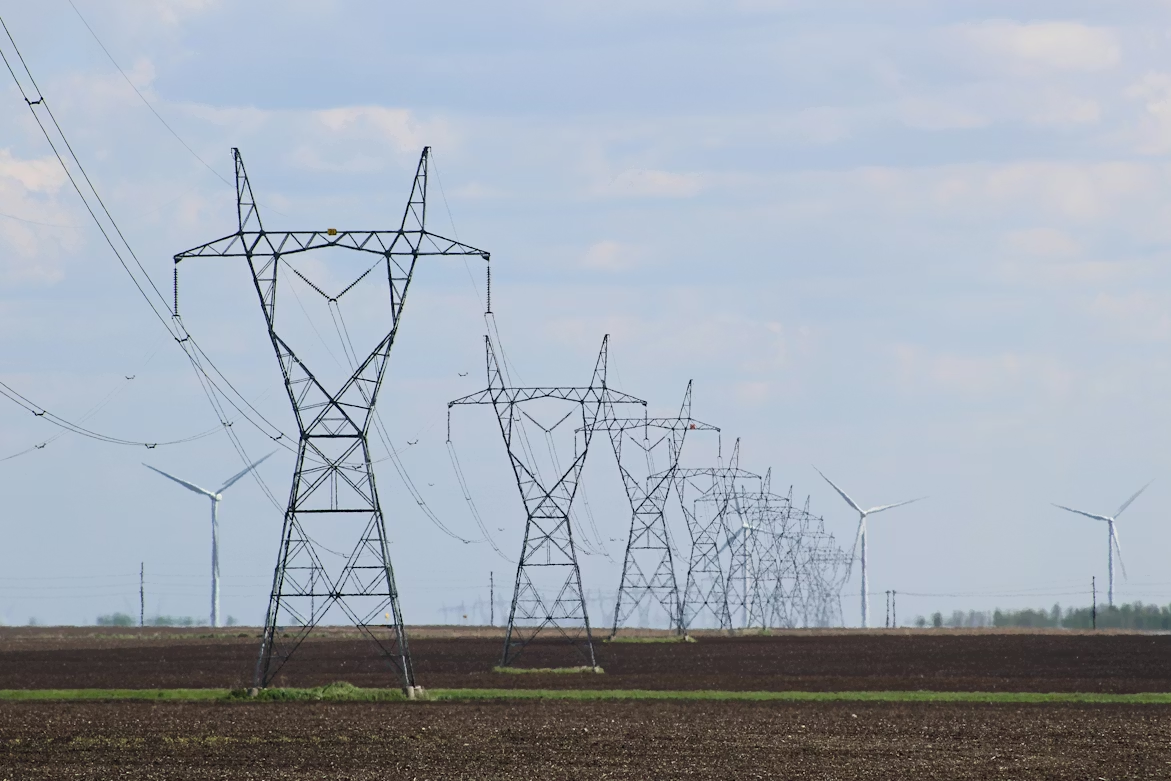
Photo by American Public Power Association on Unsplash
What is PJM?
PJM is the regional transmission organization (RTO) for our area here in the mid-Atlantic. Originally responsible for Pennsylvania, New Jersey and Maryland (thus, PJM), it now manages the electric grid for the entire mid-Atlantic and parts of the Midwest. As explained below, PJM has enormous power over electricity rates and the availability of clean energy.
PJM is a private, nonprofit membership organization, regulated by the Federal Energy Regulatory Commission (FERC), which in turn requires PJM to comply with the technical standards put out by the North American Electric Reliability Corporation.
PJM is governed by a Members’ Committee, made up of stakeholders including power generators, utilities, state and local governments, and consumer advocates. The Members’ Committee appoints a Board of Managers.
As the regional transmission organization, PJM takes on three main critical roles:
- Designs and manages the electric energy and capacity markets, which set consumers’ prices for electric power
- Manages the generator interconnection queue, determining which power generators and which types of power can connect to the grid
- Determines needed upgrades and additions to the transmission infrastructure, which are funded through additions to consumers’ electric bills
PJM does not generate any power itself (independent generators do that), nor does it build or own transmission lines and grid infrastructure (public utilities do that).
The energy market is a very technical function that ensures electricity is available all the time. PJM monitors electric flows and demand continuously and controls what generation is placed on the grid and where in order to meet demand reliably.
The capacity market is where PJM forecasts expected load (the demand for electricity) years into the future, and calculates the required supply (capacity). PJM is required to ensure sufficient capacity to meet the peak hour on the highest demand day in ten years, plus a margin, currently 19%, for exceptional circumstances. PJM cannot reject load demand – it must plan for all requested demand. It does this by running a clearing auction. Power generators, fossil fuel, nuclear, renewable alike, submit bids to supply electricity to PJM. PJM then starts with the lowest bid, and accepts bids, from low to high, until its required capacity is reached. The generators whose bids are accepted “clear” the market, and all generators are paid the same clearing price. The clearing price is the last, or highest, bid received. The idea is to incentivize generators to provide the lowest price they can profitably offer, since they know they will get an even higher price if more expensive generators are needed to meet capacity requirements, and lower cost generators are favored since they are more likely to clear – that is, have their bids accepted.
Meeting demand and ensuring a reliable grid are the core objectives – affordable and sustainable power are not core concerns. “PJM is aware of environmental and social impacts and takes them into consideration when evaluating all submitted proposals,” but “PJM’s driving approach is to determine efficient, cost-effective, constructible and scalable projects to serve electricity demand in a timely fashion.” (FAQ: PJM’s Role in Regional Planning and RTEP Windows)
Approved generators must then get in line – the interconnection queue – to connect to the grid. PJM decides which projects connect based on need, location, and grid reliability concerns.
If PJM determines, using very sophisticated technical modelling, that grid transmission upgrades will become necessary to reliably transmit the required capacity, then it will solicit proposals from developers to build it (think new transmission towers, lines and substations), evaluate the proposals, and then accept those it thinks best. It is then up to winning developers to go through state and local permitting processes.
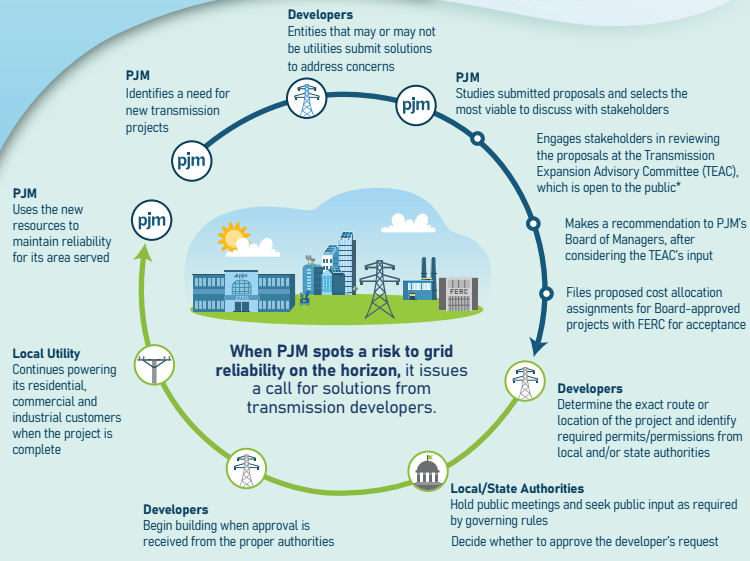
Source: How Transmission Projects Are Planned for the Regional Electric Grid
The costs of transmission upgrades are then passed through to local utilities by PJM using a cost allocation process based on the upgrade’s location, voltage and other factors. This process is simpler if an upgrade benefits a single utility or area, more complicated if the benefits are more diverse. The cost allocation method is approved by FERC and managed by PJM. Costs borne by a utility are passed on to that utility’s customers, subject to approval by state public service commissions. See Transmission Project Costs and Charges from the Consumer Advocates of the PJM States’ Transmission Handbook, vol. VI, for more details than you could ever need. As stated in that document, “the electricity costs paid by consumers is at least partly determined by the tariff and rules under which PJM operates.” (p. 27)
Why Does it Matter?
PJM plays a crucial role in determining the prices we all pay for electricity by setting the wholesale price in its capacity auction, determining what and where transmission lines are built, and deciding what type of electric generation is connected to the grid.
The massive new demand for power from data centers in the PJM region has significantly increased the clearing, or wholesale price of electricity, which flows through to the price consumers pay. Recall that the clearing price in PJM’s auction is the most expensive generation offered to meet the last part of demand. Thus, additional energy needs of new data centers’ (or any large power demand customer, though in our area data centers dominate) push the wholesale price up to very high levels.
Historically, PJM has brought online electricity generation heavily reliant on fossil fuels and nuclear power. The energy source mix as of December 15, 2025, is 66% fossil fuels and over 90% fossil fuels and nuclear. Only about 7% is from renewables, and half of that is hydroelectric. Coal still makes up 20% of PJM’s electricity generation!
Source: PJM Markets and Operations
PJM-recommended transmission lines, driven largely by new demand fromdata centers, impact land use and the environment. For instance, the proposed Maryland Piedmont Reliability Project would bring power from the Peach Bottom nuclear power plant in Pennsylvania through an existing Baltimore Gas & Electric transmission line right-of-way in northern Baltimore County, then through Carroll County and into an existing power station in southern Frederick County. Electricity from that substation is then expected to go under the Potomac River to Northern Virginia, where several large data centers need extra power for their operations. The proposed route has encountered significant opposition from local landowners and environmentalists.
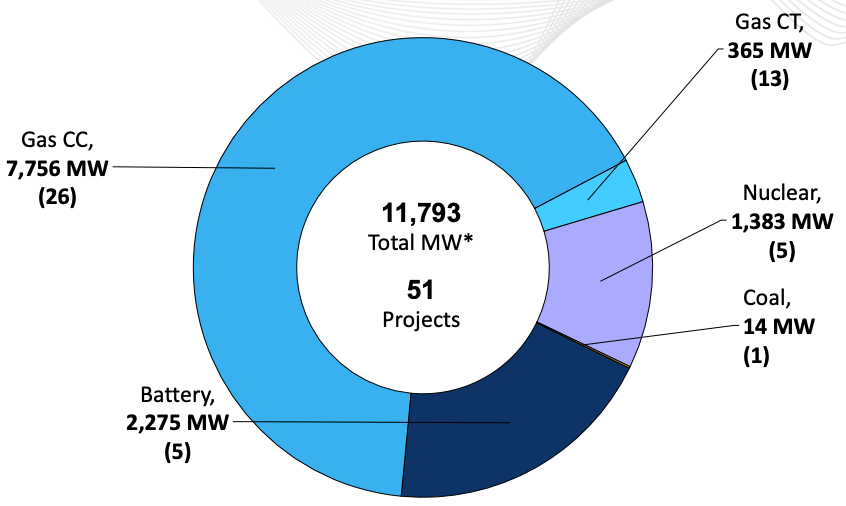
Finally, PJM has managed the interconnection queue in a very problematic manner. It has been very slow in approving new projects’ connections, delayingthe provision of renewable energy that is otherwise ready to go. PJM’s grid reliability concerns have led it to favor legacy generation, notably gas and nuclear, at the expense of less expensive wind and solar. Indeed, in its recent initiative to speed up the interconnection queue PJM introduced its “Reliability Resource Initiative” intended to fast track 51 projects of new generation ready to connect within the next few years. The result? 46 of 51 projects and 80% of the new power is fossil fuel (mostly gas) or nuclear, with no solar or wind at all.
Source: PJM Reliability Resource Initiative Results Summary, May 6 2025
How can you help?
As a private membership organization, it is difficult to impact PJM’s decisions directly. But we can influence PJM through its own members, and through our elected officials with whom PJM must work.
While the vast majority of PJM members sitting on the Members Committee are utilities, power generators, and trading firms affiliated with generators (see PJM Oversight and Transparency), some local jurisdictions are represented. Frederick County, Virginia, the towns of Berlin and Thurmont in Maryland, among others, are voting members that can be influenced by their constituents. Residents of other jurisdictions can encourage their local officials to also request membership.
In Maryland, the PJM voting member Office of People’s Counsel (OPC) was created to protect Maryland residential utility customers from unfair sales practices and unreasonable rates for services such as electricity and natural gas, in a manner consistent with the State’s environmental and greenhouse gas reduction goals. The People’s Counsel is appointed by the Maryland Attorney General. OPC has been active in proposing reforms to PJM’s processes. Maryland residents can encourage OPC to continue doing so, and to include environmental concerns in these efforts in alignment with its mission. <<Maybe we want to give kudos to David Lapp and mention that his term is nearly over here >>
All PJM states’ consumer advocate or attorney general offices are represented via the Consumer Advocates of the PJM States organization. While the organization’s current mission is solely ensuring reasonable prices, it can be encouraged through its board of state officials to include environmental concerns or, at least, explicitly address data center impacts on prices.
Finally, let your state representatives know you want them to pressure PJM to act in the interest of residents and the environment, not of large customers like data centers. A coalition of state legislators across nine states and the District of Columbia, organized by Maryland State Senator Katie Fry Hester, proposed changes to how PJM handles costs for new data centers. Four state governors, including Maryland and Virginia, created their own proposal, in partnership with the utility Excelon and the data center industry trade association Data Center Coalition that would expedite data center grid connection if certain conditions are fulfilled. These proposals did not address environmental concerns, and the governors’ joint proposal with the data center industry was more about expediting data center expansion than anything else. We can let our legislators and governors know that we want them to consider the social and environmental impacts of the data center expansion in our region, in addition to electric rates.
Conclusion
PJM is an opaque, private entity that impacts our lives in more ways than we may realize. Applying indirect pressure on PJM via our elected state and local officials can help move our region towards more fair and environmentally sustainable solutions to our electric grid issues, currently caused primarily by the massive expansion of data centers but in the future also impacted by increased adoption of EVs and building electrification.
To learn more about the wider issue of data centers in our region, and how you can help, please head on over to Nature Forward’s Data Center resources page.