
Sine Die Updates:
You can read our full press release on the end of session here!
Crossover Updates
Before Crossover, Governor Wes Moore and General Assembly leadership introduced the Utility RELIEF Bill, which is an omnibus bill that includes many of the energy and data center bills that we have been working on. Even if a bill contains portions of the bills that we have been working on, we still need to ensure that the full force of the original bill text is contained in RELIEF.
The RELIEF Bill, in the words of Senate President Bill Ferguson: “Maryland is at the forefront of national policy on data center development and must remain so. The recently announced Utility RELIEF Act will further advance protections against the worst impacts on data centers on our electric grid and communities. Specifically, the bill will (1) further allocate electricity supply and delivery costs to large load customers, like data centers, (2) increase transparency around load growth due to data center construction, and (3) establish a demand response program so data centers act responsibly when our electric grid is under the most strain.”
Bill Summaries
This past summer, Nature Forward set up the Marylanders for Data Center Reform Coalition. This Coalition is made up of environmental and community organizations working in concert, for more responsible, equitable, and transparent data center development policies at a State level.
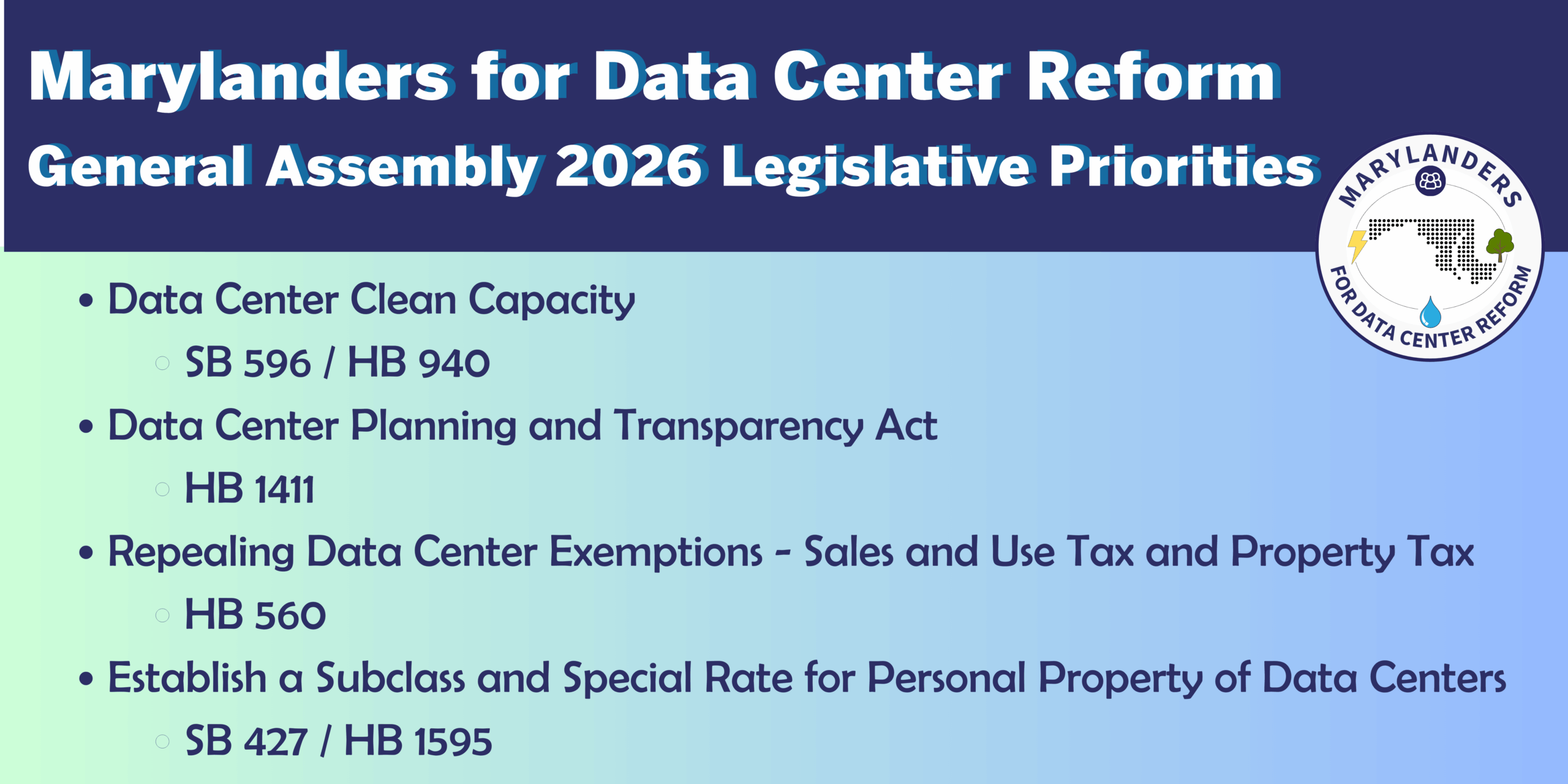
As part of our advocacy, we have four priority bills that concern data centers.
Click the arrows next to the bill names below to read a short description of each bill.
Data Center Clean Capacity (HB 940 / SB 596):
Sponsors: Delegate Lorig Charkoudian and Senator Katie Fry Hester
Our one-pager in English and Spanish below!
Data centers are putting an unprecedented strain on Maryland’s power grid. PJM (Maryland’s regional power grid operator) expects 32 GW of load growth in the next four years, 94% of which is explained by data centers alone. Our power grid is not prepared to handle this rapid, unchecked growth, and on hot days when energy usage reaches its peak, it may be overwhelmed, leading to blackouts for ratepayers across the state. The Data Center Clean Capacity Bill address this problem by:
- Establishing a voluntary demand response program: Data centers operators will be able to opt in to a program where they reduce the amount of power they pull from the grid at peak hours through battery storage, shifting workload to other facilities, and carbon-free energy generation.
- Requiring that new data centers get at least 25% of their energy from carbon-free sources or demand response.
- Prioritizing data centers that bring their own clean energy: Data centers that provide 100% of their own energy through carbon-free energy sources, battery storage, and demand response will be fast-tracked for interconnection and permitting.
- Requiring data centers to pay into a community benefit fund: Data centers must pay $1,000 per MW into the EmPOWER program, which assists low-income Marylanders.
Data Center Planning and Transparency Act (HB 1411)
Sponsor: Delegate Sheila Ruth
Data centers are major projects that have enormous effects on local ecosystems and communities. However, the planning and development process is often inaccessible to local residents, who don’t get a say in what happens in their own backyards. The Data Center Planning and Transparency Act increases transparency and community input by:
- Requiring data center operators to submit disclosure reports: Large-scale data center operators will be required to submit detailed reports to the Maryland Department of Planning, Maryland Department of the Environment, and relevant local authorities that will be made publicly available online.
- Requiring local governments to transparently plan for data center approval and development: Local governments will be required to design transparent approval processes for data center projects that include public notice and public input meetings.
- Restricting financial incentives for data center projects: Makes it more difficult for local government officials to financially incentivize data center projects.
To learn more about the Data Center Planning and Transparency Act, you can read the full bill text.
Repealing Sales and Use Tax and Property Tax Exemptions for Data Centers (HB 560)
Sponsor: Delegate Julie Palakovich Carr
Currently, in Maryland, many data centers are eligible for exemptions from statewide sales and use tax and county property taxes. This effectively subsidizes data center development, while reducing tax revenues that fund essential programs for Marylanders at both the state and local levels. Similar exemptions in other states have had larger-than-expected revenue losses, costing the state $360 million more than expected in Illinois and $850 million more than expected in Texas. This bill would help data centers pay their fair share and protect Marylanders from hidden revenue losses by:
- Repealing exemption to statewide sales and use tax: Data centers will no longer be exempt from paying sales tax on personal property like computer equipment, software, mechanical equipment, and more.
- Repealing exemptions to county property taxes: Removes the option for counties to reduce or eliminate the county property tax burden of data centers.
To learn more about the Data Center Planning and Transparency Act, you can read the full bill text.
Authority of Counties to Establish a Subclass and Set a Special Rate for Personal Property of Data Centers (HB 1595 / SB 427)
Sponsors: Delegate Julie Palakovich Carr and Senator Karen Lewis Young
Data centers are especially disruptive projects that have large impacts on their surrounding local communities. The least developers can do is pay their fair share in taxes. This bill acknowledges the unique impact of data centers by:
- Allowing counties to establish a special tax category for data centers: Counties will be allowed to set a separate property tax rate for data centers of up to 2.5 times the real property rate, helping them collect more tax revenue from data center projects in their jurisdiction.
Write Your Legislators!
Follow our step by step guide on how to vote and submit your testimony using this link!
Otherwise, you can use this form to reach out to your delegates and senators:
