
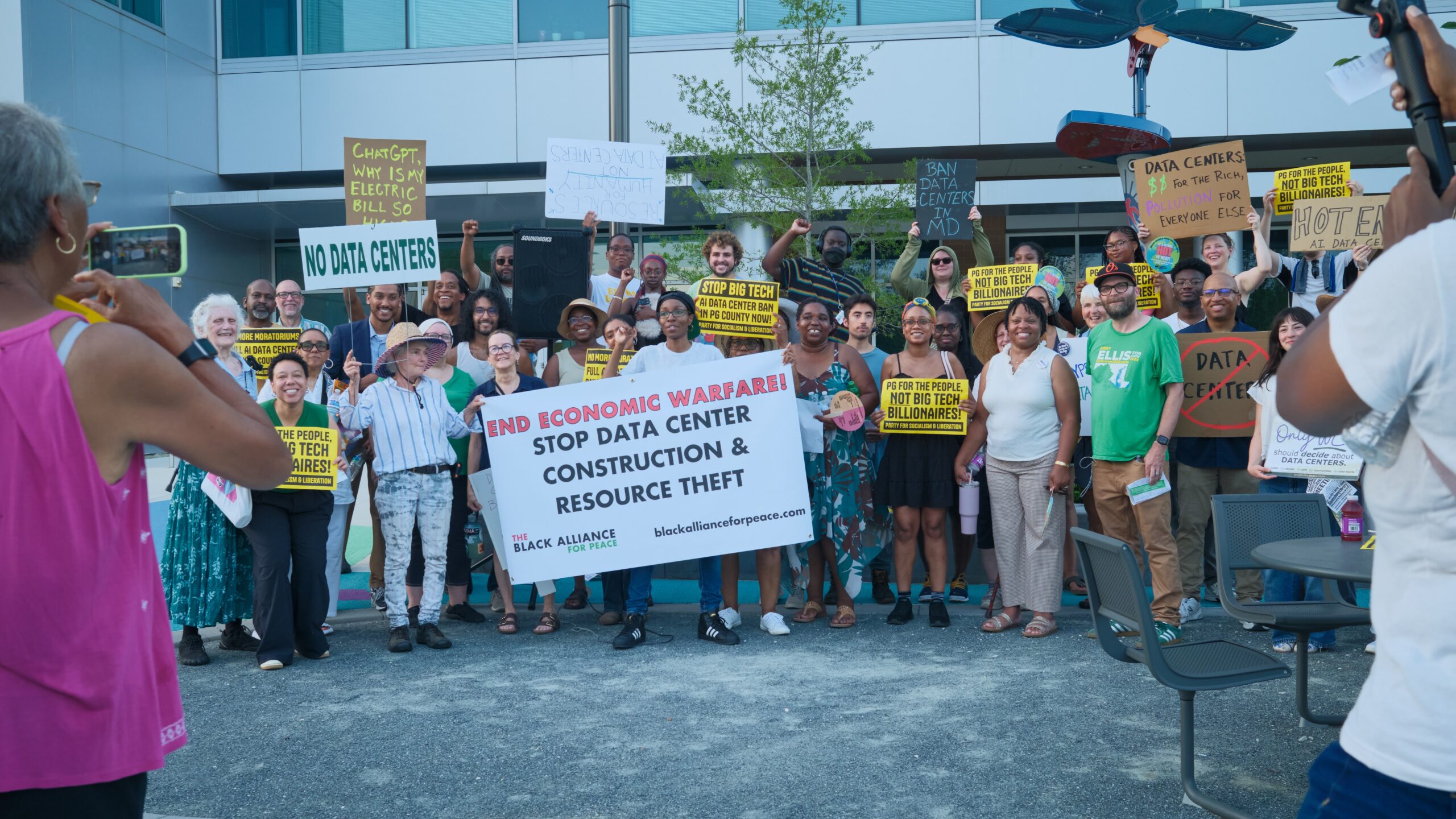
Featured image courtesy of PSL Prince George’s – Montgomery County Region July 1, 2026, Countywide Rally outside the Wayne K. Curry Admin Building.
Moratorium Update as of July 2026
On July 17, 2026, the PG County Council passed a two-year extension on the data center moratorium that blocks all applications for preliminary plans of subdivision and detailed site plans for 2 years. However, it does nothing to block future permitting applications for data centers after September 20, 2026, and Brightseat Tech Park’s preliminary subdivision plan was approved in 2024. Furthermore, qualified data centers are exempted from detailed site plans. This means that the 2-year moratorium would not apply to the Landover Data Center, and construction could move forward during the moratorium period.
Sec. 27-2300 Order of Approvals (paraphrased)
(1) Zoning
(2) Preliminary plan of subdivision [Landover approved]
(3) Detailed Site Plan [Landover Exempted]
(4) Final plat of subdivision
(5) Grading, building, and use & occupancy permits.
The moratorium only stops applications at stages 2 & 3.
Introduction
For decades the Landover Mall served as a beacon for the community of Prince George’s County. Even after its 2002 closure, the area remained a community where residents and youth gathered. Just a stone’s throw from the Washington Commanders’ Northwest Stadium, the area has always offered something to bring people together. Immediately surrounding the site today are multiple apartment complex communities, a park, a gym, grocery stores, and a prominent children’s hospital.
Today, the mall site is at the center of a battle for environmental justice (EJ) and the community has been mobilized by a threat to their health and resources in the form of a hyperscale data center campus development named Brightseat TechPark.
In 2020, Maryland and Prince George’s county passed tax breaks to incentivize new data center projects without knowing how large and prominent they could be. The next year the county removed the requirement for a detailed site plan when approving data center permits. Even worse, in 2024, the Prince George’s County Planning Board quietly approved the proposal by Lerner Enterprises to build a gigantic 4,100,000 square feet hyperscale data center campus that would demand 820 MW of electricity, without notice or opportunity to comment publicly.
Fast and effective advocacy by members of the community gave legislators a push to implement a data center permit moratorium, but as the end of the moratorium approaches, community members are hoping local regulators will provide more permanent protections.
Site Overview
In 2024, the Prince George’s County Planning Board greenlit Lerner Enterprise’s massive data center vision: a 4.1-million-square-foot campus cutting through 87 acres of land. Lerner proposed five buildings that would use approximately 100 MW of energy each, although they later estimated the campus would have a total 820 MW capacity in a 2024 presentation. Shortly after this project was proposed, the Maryland General Assembly passed SB0474, allowing data centers to build and use backup power generators without the approval from the Public Service Commission. Furthermore, specific information about the site’s planned power generation is not required to be disclosed in Maryland, leaving residents questioning to what kind of risks they will be exposed. The data center development was expected to break ground sometime in 2026, but was delayed after organized community action forced the County Council to institute a moratorium.
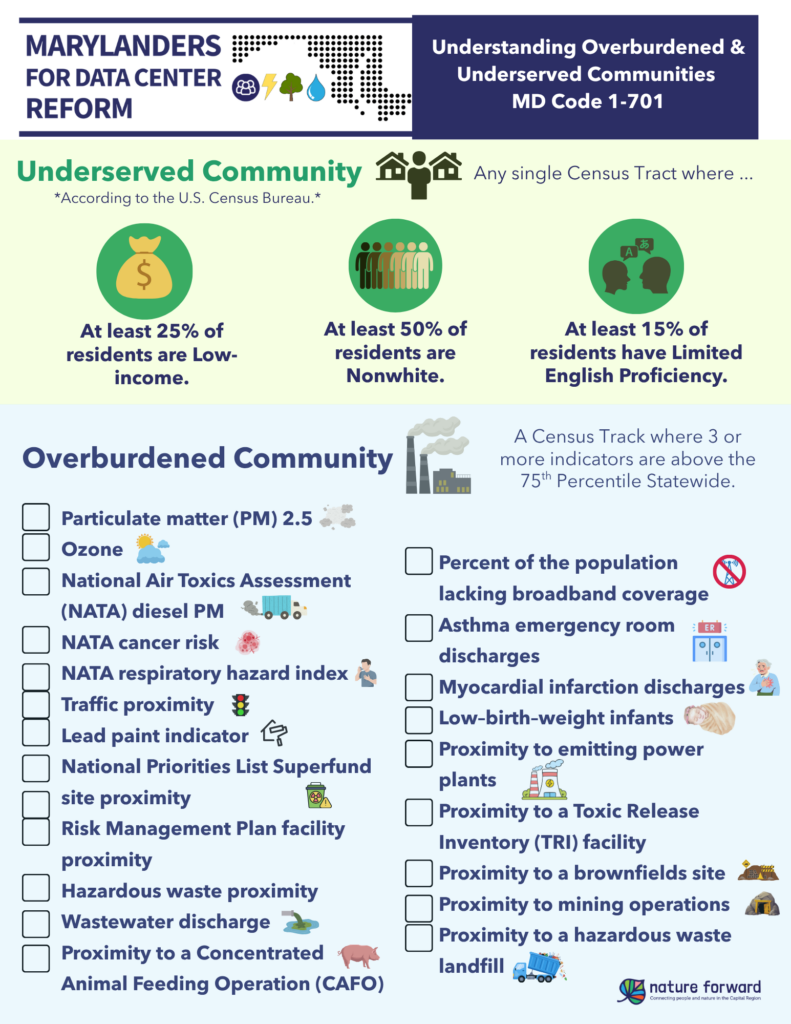
Landover is a four square mile unincorporated community of approximately 26,000 in Prince George’s County Maryland. MDEnviroScreen, a research tool used to visualize cumulative health impacts, identifies communities across Landover as being both underserved and overburdened due to its over-exposure and proximity to diesel air pollution, traffic, hazardous waste, brownfield sites, and mining operations. The population’s general demographics show a 64% Black or African American and 27% Hispanic or Latino population with a median household income of around $70k in the city, compared to $102k in the state. Some parts of the population have demonstrated a lower resilience to public health burdens due to low birth weights, high rates of asthma, and low income.
As of June 26, 2026, the particular census tract where the development is sited is not considered an overburdened community, only underserved (Census Tract ID: 24033803508). However, the residential census tract immediately adjacent to the West is an EJ community with a final score of 69.6 (Census Tract ID: 2403380340310). More interestingly, as you look further West, EJ scores rise with proximity to Brownfield sites, mining operations, and Toxics Release Inventory proximity as well as above average hospital asthma discharges (Census Tract ID: 24033803300). Use our resource on how to use the MD EnviroScreen website and input the census tract for more specific information.
Policy Research Tip: Overburdened and Underserved Communities (click or tap to learn more)
The definitions for “underserved” and “overburdened” are located in the Maryland Environmental Code §§ 1-701(7)-(8). This is where you can find the full list of environmental health indicators and those identified by the U.S. Census Bureau.
Company
Lerner Enterprises is a real estate and development company based in Rockville. Their portfolio includes a variety of office, residential, retail, hospitality, sports and entertainment assets, but currently no other data centers. In Gainesville, Virginia, Lerner Enterprises applied for a special use permit for a data center on 103.3 acres of land, then sold it six months later to NTT Data for $257.4 million in 2022.
PG county Permitting Guide
Data Center Task Force
In April 2025, the Prince George’s County Council signed a resolution to establish a Qualified Data Center Task Force to study the potential risks, community benefits, and revenue potential as well as to develop potential location and procedural policies for the siting of Qualified Data Center uses.
Policy Point: What is a Qualified Data Center? (click or tap for more info)
Qualified data centers are defined in Maryland’s Tax article §11-239(a)(5)(i) which says, a qualified data center means a data center located in the State in which an individual or corporation, within 3 years after submitting an application for the sales and use tax exemption under this section, has:
- For a data center located within a Tier I area, invested at least $2,000,000 in qualified data center personal property and created at least five qualified positions; or
- For a data center located in any other area of the State, invested at least $5,000,000 in qualified data center personal property and created at least five qualified positions.
– if you are curious about any other definitions within this section, challenge yourself by researching the portion of the code it’s located in! Laws – Statutes, Search for §11-239 under the tax code to explore some of Maryland’s data center regulation. Remember, knowledge is power!
Soon after the first few meetings of the task force, the Prince George’s County community showed great engagement with the opportunity to participate. Taylor Frazier McCollum initiated a local activism campaign with a petition that called out county officials for the lack of transparency and public engagement, but moreover to stop the proposed data center development. The signatures quickly grew to include 23,000 residents who expressed the same concerns. Since then, the No Data Center in Landover Movement has brought an overwhelming amount of attention to the Landover Brightseat TechPark Data Center Project, which has slowed development significantly.
The Public Opposition – No Landover Data Center Movement
What began as a localized effort by Taylor Frazier McCollum quickly evolved into a popular digital advocacy campaign. In response to public outcry, County Executive Aisha Braveboy signed an Executive Order in January 2026 that placed a temporary hold on permit applications for Qualified Data Centers until April 30, 2026. It has since been extended to end on September 30, 2026.
McCollum used the momentum to garner participation in organizing efforts including hosting community feedback meetings, sharing educational resources, and providing opportunities to suggest alternative developments at the site, not to mention bringing public attention to the Data Center Task Force activities. These initiatives gave community members time and procedural context to organize around the issue.
As of July 17, 2026, the PG county council has passed a two-year extension on the data center moratorium that blocks all applications for preliminary plans of subdivision and detailed site plans for 2 years. These are the two steps that developers must pass before submitting any permits and it takes about 4 months for each step. Brightseat Tech Park’s preliminary subdivision plan was approved in 2024, and PG county does not require detailed site plans for qualified data centers such as this one.
The problem, however, is the moratorium bill does nothing to block the Landover data center from applying for permits after County Executive Braveboy’s permitting moratorium ends on September 20, 2026. This means that the 2-year moratorium would not apply to the Landover Data Center, and construction could possibly move forward during the moratorium period.
Click or tap to view the full order of approvals in PG County
Sec. 27-2300 Order of Approvals (paraphrased)
(1) Zoning
(2) Preliminary plan of subdivision [Landover approved]
(3) Detailed Site Plan [Landover Exempted]
(4) Final plat of subdivision
(5) Grading, building, and use & occupancy permits.
The moratorium only stops applications at stages 2 & 3.
Furthermore, the moratorium will be invalidated if more comprehensive data center legislation is passed to address “the placement, construction, and operation of data center uses.”
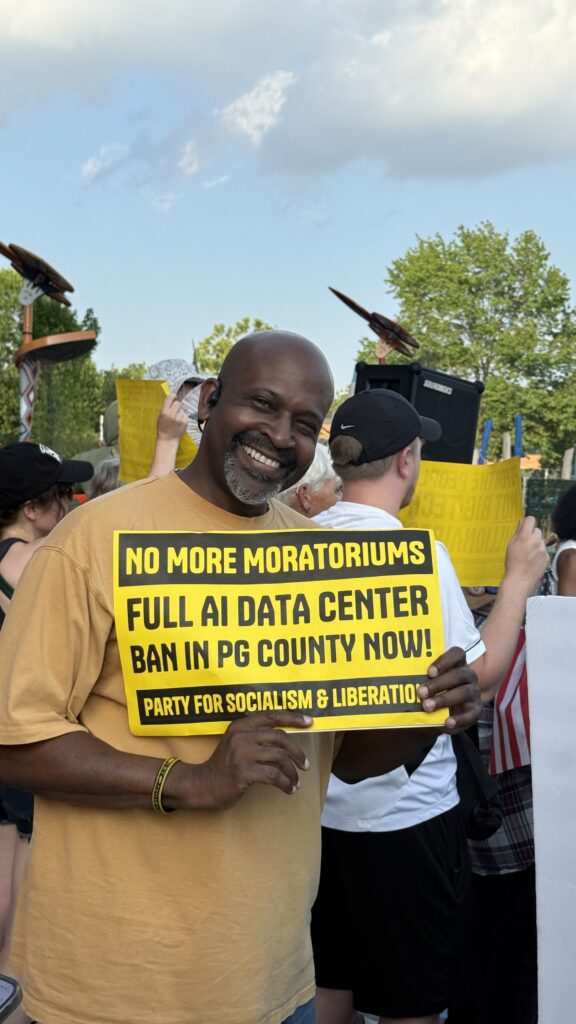
In light of this legislation, the Party for Socialism and Liberation (PSL) and the residents of Prince George’s County have continued organizing in hopes of a complete ban–not another moratorium.
Environmental Justice & Cumulative Impacts
Community members and advocacy organizations have expressed specific opposition to Lerner Enterprise’s lack of community input before proposing the project. McCollum and other advocates including researchers from the Center for Engagement, Environmental Justice and Health INC. and the Energy Equity Project; as well as various researchers and attorneys from law school environmental justice centers were brought together by the NAACP. These groups worked together and plunged into action to analyze the environmental impacts and engage with resident concerns and demands to form an independent assessment to counter the inadequacy of the analysis and conclusions of the data center task force report. Their research has been compiled into the People’s Report, which can be read here.
After months of community engagement and research, the report prepared by the NAACP and their partners revealed that Prince George’s County residents were concerned about noise pollution, energy sustainability, and workforce initiatives. Survey respondents from Prince George’s County demanded ongoing environmental monitoring, implementing demand response programs, transparency related to ongoing and new data center operations, and prioritizing the use of renewable energy sources.
Residents of “Data Center Alley” in Northern Virginia chimed in with their concern about the development as well. 82% of survey respondents strongly agreed or agreed that noise pollution would be a concern and 83% of residents expressed concern about the environmental impact on their air quality. 75% of respondents from both states indicated that regardless of whether their demands are met, they do not want a data center in their community, reflecting an attitude of unflinching opposition to AI data center development.
What is Demand Response? Click or tap to learn more
Demand response is a system where large-load electricity consumers adjust their energy usage to help balance supply and demand.
In conclusion, the moratorium has been extended but its impacts have been restricted. The changes it makes doesn’t affect the Landover development since it’s past the phases the moratorium targets. Furthermore, the results of the Data Center Task Force Report show that the infrastructure required to support an 820 MW data center could permanently alter the economic and environmental landscape of Prince George’s County.
Meanwhile, the community is uniting to ban data centers outright and, while they are clear on their stance, it is unclear whether the County Council will listen to their constituents or allow Prince George’s County to become the next data center alley.
Timeline
2020 – State and County pass data center sales and use tax exemptions.
2021 – PG county Council creates new zone use regulation for Qualified Data centers which allows them to be in non-industrial zones, and critically removes the requirement for a detailed site plan.
August 2023 – Lerner Enterprises files a preliminary qualified data center application.
March 2024 – Brightseat TechPark land use permit approved by the PG County Planning Council.
May 2024 – Maryland Legislators repeal regulations for data center back up generators SB0474
April 2025 – PG County passes CR–016-2025 to establish the Qualified Data Center Task Force
July 2025 – Taylor Frazier McCollum begins a petition to stop development, ultimately gaining more than 23,000 signatures.
July – October 2025 – Data Center Task Force holds community meetings
November 30, 2025 – Data Center Task Force Releases their final report.
December 2025 – Maryland Data Center Study Bill SB0116 is vetoed by Governor Moore, then overridden by the General Assembly.
Jan – April, 2026 – Data Center Moratorium Period.
March 2026 – PG county council introduces CB-019-2-2026 and CB-020-2026, ordinances to repeal the exemption from a detailed site plan review for qualified data centers and to mandate pre-application neighborhood meetings for land use permits.
May 2026 – Aisha Braveboy extends Data Center moratorium to June 30, 2026.
June 29, 2026 – Council Member Oriadha introduces resolution to establish a 2 year moratorium on the operation of hyperscale data centers which would include an extension on the hold on accepting, considering, and processing permit applications until September 30, 2026.
July 7, 2026 – 2 year moratorium bill passed by the County Council.
September 1, 2026 – Deadline for state-level impact report from SB0116.
Call to Action
- Connect with PSL and attend their meetings to engage with local efforts in PG County @psldc on Instagram.
- Add your name to the original petition to “Stop Data Center at Former Landover Mall Site“
- Send a letter to Representatives of the County Council and tell them to vote to ban data centers entirely
- Stay up to date with community organizations involved in opposing the project such as No Data Center in Landover
- Read Nature Forward’s Conservation Blog on efforts to Stop the Data Center at Landover Mall and sign up for our Action Alerts to stay informed!
Advocacy Groups Involved
Advocacy Groups
DC Liberation Center, Party for Socialism and Liberation (Main Organizers), Indivisible Prince George’s County, ANSWER Coalition, Greenbelt Resistance Network, Friends of Lower Beaverdam Creek, Greenbelt Climate Action Network, Juventud Unida por la Independencia DMV, Mid-Atlantic Region of The Black Alliance for Peace (BAP Mid-Atlantic), Interfaith Power & Light (DC.MD.NoVa), Metro DC DSA, Center for Engagement Environmental Justice and Health INpowering Communities (CEEJH INC), Concerned Citizens of Prince George’s County D4 and Surrounding Areas Inc., Concerned Citizens for Bail Reform, Sunrise DC, Greenpeace
Student Groups
17 for Peace and Justice, University of Maryland College Park NAACP, UnLocked Project
Neighborhood Associations
Tantallon North Area Civic Association, Woodlawn Community Association, Inc., Central Coalition
Other
Joe’s Movement Emporium and Creative Suitland Arts Center
